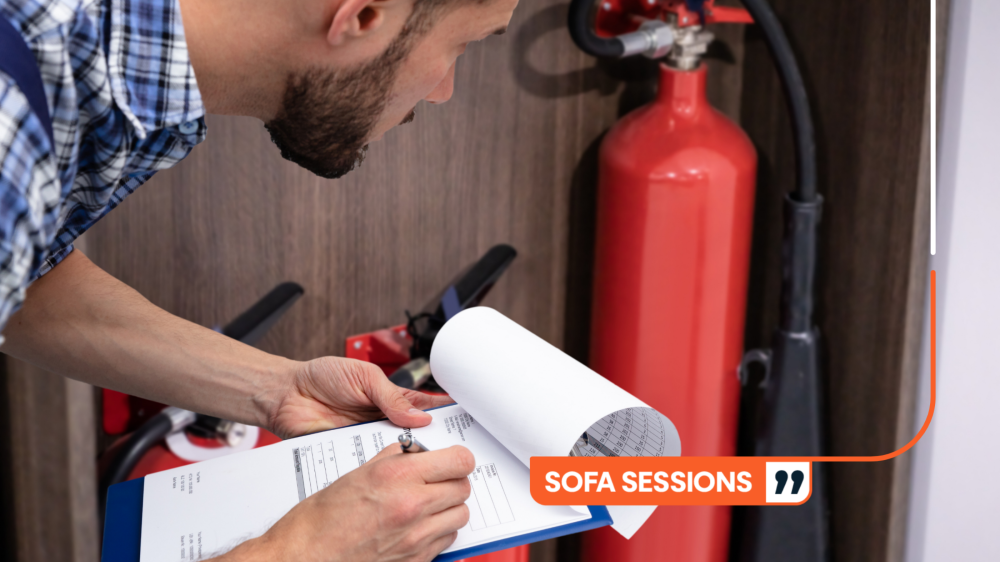
In this blog, we summarise the key insights and discussions from the Health & Safety Sofa Session, Fire Safety Failures: What Recent Audits are Revealing.
With Bonfire Night taking place tomorrow, this is an ideal time to revisit fire safety arrangements and ensure that schools remain vigilant, particularly as we enter the winter months when building usage patterns change, electrical equipment use increases, and dark mornings and evenings place greater reliance on emergency lighting and evacuation procedures.
Why Fire Safety Matters
Schools are busy and often complex environments.
Many contain:
-
Large numbers of occupants
-
Multiple buildings
-
Vulnerable individuals
-
Specialist teaching areas
-
Significant electrical equipment
-
Contractors working on site
Fire Safety Risks
Risk to life.
Whilst most schools have effective evacuation arrangements, a fire that spreads rapidly due to poor compartmentation, blocked escape routes, defective fire doors, or failures in fire safety management can place staff, pupils, visitors, contractors, and attending firefighters at increased risk.
Disruption to education can be substantial.
Even relatively small fires can render classrooms, specialist teaching spaces, kitchens, offices, or entire blocks unusable for extended periods. Schools may need to relocate pupils, provide temporary accommodation, reduce curriculum delivery, or alter timetables while repairs are underway.
Loss of resources
Fires can destroy IT equipment, teaching materials, student work, specialist equipment, records, and resources that may have taken years to accumulate. Smoke damage alone can affect areas well beyond the room where the fire originated.
Financial impact
Costs may include building repairs, temporary accommodation, replacement equipment, increased insurance premiums, specialist cleaning, and staff time associated with managing the incident and recovery process. Even when insured, the indirect costs and management time can be significant.
Reputation impact
Parents, governors, trusts, regulators, and the wider community expect schools to provide a safe environment. Following a serious fire, questions are often asked about maintenance, fire safety management, risk assessments, and whether warning signs had been identified but not addressed.
Recent Audit Findings
Over the last year, school audits and fire risk assessments have revealed several recurring themes.
Common findings include:
-
Fire doors being wedged open
-
Missing or damaged intumescent strips and smoke seals
-
Incomplete compartmentation records
-
Fire stopping around service penetrations requiring improvement
-
Emergency lighting testing records not readily available
-
Delays in completing fire risk assessment actions
-
Uncertainty around Responsible Person duties
The encouraging news is that most schools are actively working to address these issues and are making significant progress.
-2.png)
Fire Doors: More Than Just Doors
One of the most common audit findings concerns fire doors.
Fire doors are designed to:
-
Resist the spread of fire
-
Limit smoke movement
-
Protect escape routes
-
Provide occupants with valuable evacuation time
However, a fire door only works if it remains effective.
Common Issues
-
Doors wedged open
-
Missing or damaged seals
-
Damaged frames
-
Faulty self-closing devices
-
Excessive gaps around the door
A well-maintained fire door can be the difference between a small, contained incident and a major building fire. Consider carrying out regular visual inspections and ensuring defects are reported promptly.
Many School Business Managers (SBMs) and Facilities/Premises Managers are expected to manage estates, contractors, health and safety, compliance, lettings, maintenance, security, staffing issues, budgets, and day-to-day operational matters. Fire safety visual inspections are often only one of dozens of competing priorities.
Practical solutions schools could consider:
-
Fire Warden ownership
-
Allocate sections of the school to fire wardens
-
They undertake monthly visual checks of fire doors, extinguishers, escape routes and signage
-
Departmental checks
-
Science technicians inspect science areas
-
Site team inspect plant rooms
-
Kitchen managers inspect kitchen escape routes and fire blankets
-
Termly fire safety inspections
-
Undertaken by an external consultant
-
Assures FRA reviews
-
Fire safety champions
-
Identify key staff members across departments
-
Spread responsibility rather than relying solely on the SBM or Facilities Manager
The Importance of Compartmentation
Compartmentation means dividing a building into fire-resistant sections that slow the spread of fire and smoke.
This is often hidden behind walls and above ceilings, making defects difficult to identify without inspection.
Examples of compartmentation defects include:
-
Unsealed cable penetrations
-
Damaged fire stopping
-
Poorly installed building services
-
Historic alterations which have breached fire-resistant structures
Many schools are currently undertaking surveys and improvement programmes to better understand and improve compartmentation within their buildings. This work can be extensive and may take time, but it is a crucial part of an effective fire safety strategy.
In a school environment, a fire originating in a classroom, plant room, electrical riser, kitchen, or storage area could spread rapidly through unprotected voids and service penetrations, allowing smoke and fire to bypass the compartment walls and floors intended to contain it. This may result in the early loss of escape routes, compromise protected stairways and corridors, increase property damage, and place staff, pupils, visitors, and responding firefighters at greater risk.
-2.png)
Emergency Lighting
As we move into the winter period, emergency lighting becomes increasingly important. Emergency lighting is designed to operate if normal lighting fails, helping occupants safely evacuate the building.
Schools should ensure:
-
Monthly functional tests are completed
-
Annual duration tests are undertaken
-
Defects are recorded and addressed
-
Testing records are retained
During audits, emergency lighting is often installed and operational, but testing records can sometimes be incomplete or difficult to locate. If it isn't recorded, it can be difficult to demonstrate compliance.
Understanding the Responsible Person
One area that can sometimes cause uncertainty is the role of the responsible person.
In schools, this is typically the employer, governing body, trust, or other duty holder with overall control of the premises.
The role of the responsible person continues to become increasingly demanding as fire safety legislation evolves and places greater emphasis on the management, recording, and sharing of fire safety information. Recent changes introduced through Section 156 of the Building Safety Act 2022 have strengthened the requirements placed upon responsible persons, including the need to record fire risk assessments in full, formally document fire safety arrangements, cooperate with other responsible persons where premises are shared, and maintain appropriate fire safety records.
Whilst duties can be delegated, accountability ultimately remains with the responsible person.
It is therefore important that fire safety is regularly discussed at leadership level and that recommendations are actively monitored to completion.
Bonfire Night Safety Considerations
As Bonfire Night approaches, schools may wish to remind staff, pupils and parents about fire safety both on and off site.
Consider sharing messages around:
-
Safe use of fireworks
-
Attendance at organised displays
-
Keeping spectators at a safe distance
-
Safe disposal of sparklers
-
The importance of supervision
Schools hosting events should ensure:
-
Fire risk assessments are reviewed
-
Emergency arrangements are appropriate
-
Access routes remain clear
-
Fire-fighting equipment is available where necessary
-2.png)
What Good Looks Like
Schools demonstrating strong fire safety management often share the following characteristics:
✅ A current Fire Risk Assessment
✅ Clear ownership of actions
✅ Routine fire door inspections
✅ Effective defect reporting processes
✅ Regular testing and maintenance
✅ Accurate record keeping
✅ Leadership engagement
✅ Ongoing review and improvement
The strongest schools view fire safety as a continual process rather than an annual compliance exercise.
Key Takeaways
To conclude, here are some key messages:
-
Fire doors and compartmentation remain critical areas of focus
-
Emergency lighting testing and record-keeping should be routinely monitored
-
Responsible Persons should understand and actively oversee fire safety arrangements
-
Bonfire Night presents an excellent opportunity to reinforce fire safety awareness
-
Fire safety is most effective when it forms part of everyday school management
Fire safety is not simply about responding to emergencies. It is about creating the conditions that prevent them, protecting those in our care, and ensuring education can continue safely when the unexpected occurs.
How Judicium Can Help...
Judicium Education's Fire Risk Assessments are tailored to the realities of education settings, assessing your buildings as they are actually used and giving you clear, prioritised actions to strengthen fire safety. Fill out our enquiry form here.
If you require any support in any of these steps or would like to talk to someone about some support for your school or trust, please do not hesitate to call us on 0207 336 8403 or email enquiries@judicium.com
If you’d like to review Judicium’s forthcoming sofa sessions, please click here.
Follow us on X: @JudiciumEDU.
© This content is the exclusive property of Judicium Education. The works are intended to provide an overview of the sofa session you attend and/or to be a learning aid to assist you and your school. However, any redistribution or reproduction of part or all of the contents in any form is prohibited. You may not, except with our express written permission, distribute or exploit the content. Failure to follow this guidance may result in Judicium preventing you from accessing our sessions and/or follow-up content.
_1000.png)
(1)_1000.png)