
(1)_1000.png)
Case Study: Key-Person Dependency Risks
A school relied almost entirely on its long-serving Site Manager to manage fire safety checks, asbestos register access, contractor control, emergency lighting inspections, Legionella monitoring and Accident reporting. There was little documented procedure, and other staff had limited understanding of these responsibilities.
The Site Manager was unexpectedly absent for six weeks due to illness. During this period:
- Weekly fire alarm tests were missed
- Contractors carried out maintenance work without being briefed on asbestos locations
- Water temperature monitoring records were not completed
- A fire exit became obstructed and remained unchecked
An audit identified multiple compliance gaps and near misses.
What are the Health & Safety Risks?
- Failure to comply with fire safety requirements
- Increased risk of asbestos disturbance by contractors
- Potential Legionella exposure
- Inability to demonstrate legal compliance during inspection
The school had a significant key-person dependency risk. Knowledge, records, and responsibilities were concentrated with one employee rather than being embedded within a management system.
Corrective Actions Made By the School
- Created documented H&S procedures
- Introduced deputy roles for critical H&S functions
- Established a compliance calendar accessible to senior leaders
- Cross-trained the Business Manager and Caretaker
- Stored H&S records electronically rather than with one individual
- Reviewed succession and business continuity plans annually
Lessons Learned by the School
Critical safety functions should never depend on a single individual. Schools need resilient systems, not just competent people. Deputies and documented procedures are essential for business continuity. Senior leaders must have visibility of statutory compliance activities.
This issue commonly arises where a school's health and safety arrangements rely heavily on one individual (for example, the Site Manager, Business Manager, Educational Visits Coordinator, or Headteacher). The HSE and Department for Education stress that schools must have competent health and safety arrangements that do not rely on a single person.
Key-Person Dependency Absence
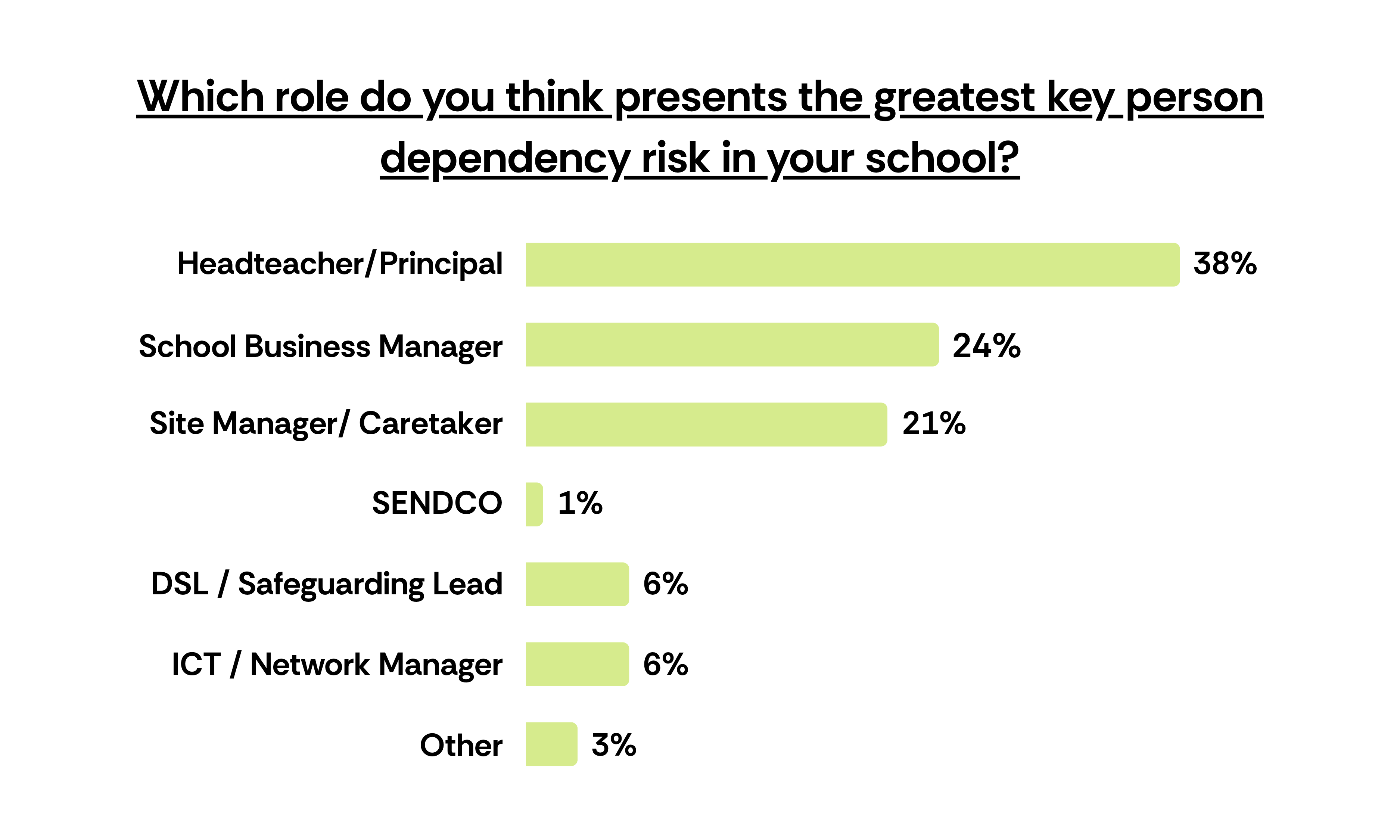
Many schools unknowingly rely on one or two individuals who hold critical knowledge, manage key compliance activities, or perform essential operational tasks. If that person is absent, off sick, or leaves the organisation, could the school continue to operate effectively?
.png)
Things that need to be considered include key processes documented and accessible to other members of staff, adequate planning for critical roles, whether deputies have been identified and trained, and whether statutory, safeguarding, premises, or health and safety responsibilities can still be fulfilled in the absence of key personnel.
Key person dependency is often a hidden risk that only becomes apparent when a member of staff is unavailable. Building resilience through cross-training, succession planning, and documented procedures can significantly reduce operational disruption.
.png)
Many school risk registers focus heavily on statutory compliance and regulatory requirements, but do they truly reflect the risks that could disrupt day-to-day operations?
When reviewing your school's risk register, consider whether it captures emerging and evolving risks or focuses primarily on compliance requirements. Operational risks such as staffing shortages, key person dependency, budget constraints, and contractor failures should be given appropriate consideration alongside traditional health and safety hazards. It is also important to assess how frequently risks are reviewed and updated in response to changes within the school environment. Leaders and governors should be actively discussing risks that could impact strategic objectives, pupil outcomes, or business continuity. Ultimately, the risk register should reflect the issues that pose the greatest threat to the school's successful operation, rather than simply documenting matters that may be scrutinised during an inspection.
A risk register should be more than a compliance exercise. The most effective registers capture both statutory requirements and the real-world risks that could prevent the school from achieving its objectives.
Schools face a range of significant risks that can affect day-to-day operations, financial stability, educational outcomes, and overall resilience. Key operational risks include:
- Key person dependency, where critical knowledge or responsibilities are held by a single individual
- Recruitment, retention, and staff absence challenges, impacting the school's ability to deliver services effectively
- ICT failures, cyber-attacks, utility outages, or contractor failures, which can disrupt normal operations
- Budget pressures, including funding reductions, unexpected expenditure, and rising energy or staffing costs
- Strategic risks, such as falling pupil numbers, reduced parental confidence, failure to meet school improvement objectives, or changes in government policy
- Safeguarding and welfare concerns, including safeguarding incidents, increasing pupil mental health needs, poor attendance, and behavioural issues
- Premises-related risks, such as building deterioration, structural concerns, fire safety failures, and H&S and security breaches
- Reputational risks, arising from complaints, adverse inspection outcomes, negative media coverage, or social media incidents
These risks should be regularly reviewed to ensure the school can achieve its objectives, maintain business continuity, and provide a safe and effective learning environment.
A strong risk register looks beyond compliance and identifies the practical risks that could impact pupils, staff, finances, reputation, and the school's ability to achieve its strategic objectives. Often, these "real-world risks" are the ones that cause the greatest disruption when they materialise.
Compliance Vs Reality
Many school risk registers are heavily weighted towards compliance risks because these are linked to legal duties and inspections. However, dynamic risks are often the issues most likely to disrupt the school's ability to operate effectively.
Compliance Risks
These are risks associated with meeting statutory and regulatory requirements:
- Failure to complete fire alarm testing and fire risk assessments
- Inadequate first aid provision
- Non-compliance with asbestos management requirements
- Failure to undertake legionella monitoring
- Insufficient safeguarding policies and training
- Failure to complete mandatory health and safety inspections
- Incorrect reporting of incidents under RIDDOR
- Non-compliance with GDPR and data protection requirements
Dynamic or Operational Risks
These are risks that emerge from changes in the operating environment and can significantly affect school performance and continuity:
- Key person dependency on a Site Manager, SENCO, Business Manager, or Headteacher
- Difficulties recruiting and retaining teaching staff
- High levels of staff sickness absence
- Cyber-attacks or prolonged ICT outages
- Contractor failure during critical maintenance projects
- Rising energy costs creating unplanned budget pressures
- Increased pupil mental health needs exceeding available support
- Falling pupil numbers affecting future income
- Parental complaints escalating through social media
- Structural issues with ageing buildings impacting service delivery
Simple Comparison
| Compliance Focus | Reality Focus |
|---|---|
| Have fire drills been completed? | What happens if the Site Manager is absent for three months? |
| Is safeguarding training up to date? | Do we have sufficient staff capacity to manage increasing safeguarding demand? |
| Is the asbestos register maintained? | What if specialist contractors are unavailable during an emergency repair? |
| Have risk assessments been completed? | What could prevent us from delivering education effectively next term? |
| Are statutory checks recorded? | What keeps school leaders awake at night? |
The Hidden Costs of Deferred Maintenance
School buildings and infrastructure are critical assets that directly support the safety, wellbeing, and learning experience of pupils and staff. However, when maintenance is delayed or underfunded, minor defects can quickly develop into significant issues requiring costly emergency repairs and unplanned expenditure.
A reactive approach to maintenance often results in higher costs, increased disruption to teaching and learning, and greater health and safety risks. Problems such as roof leaks, heating failures, electrical faults, deteriorating building fabric, and ageing infrastructure can escalate if not identified and addressed through planned preventative maintenance.
Effective asset management requires schools to understand the condition of their estate, prioritise investment based on risk, and take a long-term approach to maintenance planning. By addressing issues early and maintaining assets proactively, schools can reduce costs, improve reliability, enhance safety, and avoid the operational disruption that often accompanies emergency repairs.
The key challenge for leaders is to balance short-term budget pressures against the long-term consequences of deferred maintenance. What may appear to be a cost saving today can often become a much larger financial and operational burden in the future.
Some examples to use:
- A small roof leak is ignored because funding is unavailable. Over time, water damages ceilings, lighting, IT equipment, and classroom furnishings, resulting in a repair bill many times greater than the original roof repair
- Boiler servicing is postponed to reduce short-term expenditure. The boiler subsequently fails during winter, leading to expensive emergency call-out costs, temporary heating measures, and disruption to lessons
- Minor potholes or damaged pathways are left unrepaired. Eventually they become slip or trip hazards, increasing the risk of injury claims and requiring more extensive resurfacing works
- Guttering and drainage systems are not regularly maintained. Blockages cause water ingress, damp, and deterioration of the building fabric, leading to costly remedial works
- Fire doors are not routinely inspected and maintained. A later inspection identifies multiple defects, resulting in urgent replacement works, increased costs, and potential compliance concerns
- Ageing electrical installations are not upgraded in line with condition surveys. Electrical failures then occur unexpectedly, requiring emergency repairs and causing disruption to teaching and school operations
- Window and roofline maintenance is deferred. What begins as a minor repair develops into widespread water penetration, requiring replacement rather than repair
- Playground or sports facilities receive minimal maintenance. Deterioration eventually results in closure of facilities, expensive refurbishment works, or restrictions on use
- Building condition surveys identify structural concerns, but action is delayed. The deterioration worsens, significantly increasing repair costs and potentially affecting building availability
.png)
The poll results from webinar attendees showed that 31% found roof leaks and water ingress to be the highest maintenance issue that could become more costly with building fabric deterioration in second at 25%. 70% found that the biggest barrier to address these issues is insufficient budgets.
.png)
How to Identify Hidden Risks in Your School
Identifying hidden risks requires schools to look beyond traditional compliance requirements and take a broader view of the factors that could affect their ability to operate safely and effectively. This involves reviewing key areas such as staffing resilience, business continuity, premises condition, cyber security, financial sustainability, safeguarding pressures, and organisational dependencies.
Leaders should engage with staff, governors, and other stakeholders to understand emerging concerns, analyse trends, review near misses and incidents, and challenge assumptions about existing controls.
By adopting a proactive and structured approach to risk identification, schools can uncover vulnerabilities before they develop into significant issues, enabling informed decision-making, effective resource allocation, and greater organisational resilience. Ultimately, the goal is to ensure that risks are managed before they become problems, rather than responding once disruption has already occurred.
"If the school experienced a major disruption tomorrow, what would we wish we had identified and planned for today?"
Once hidden risks have been identified, schools should implement a structured improvement plan to ensure risks are actively managed rather than simply recorded.
1. Assign Ownership
- Allocate each significant risk to a named individual
- Ensure responsibility sits with the person best placed to influence controls and outcomes
- Report ownership through senior leadership and governance structures
2. Prioritise Risks
- Assess each risk based on likelihood and potential impact
- Focus resources on high-impact, high-likelihood risks first
- Create a "Top 10 Strategic Risks" list for leadership review
3. Develop Mitigation Actions
For each significant risk:
- Define what controls are already in place
- Identify any gaps
- Agree actions to reduce the likelihood or impact of the risk
- Set realistic target dates for completion
4. Build Resilience
Examples include:
- Training deputies to reduce key-person dependency
- Creating business continuity plans
- Digitising critical records and procedures
- Establishing contractor contingencies
- Developing succession plans for key roles
5. Integrate with Existing Processes
- Include risk discussions in leadership meetings
- Align risk management with school development plans
- Consider risks during budgeting and resource allocation
- Link risks to strategic objectives
6. Monitor Progress
- Review risks termly or more frequently where necessary
- Track actions through a risk action plan
- Update risk ratings as controls improve or circumstances change
- Escalate significant concerns to governors
7. Test the Plan
Ask practical questions such as:
- What if the Site Manager was absent for six months?
- What if the school's internet failed for a week?
- What if pupil numbers fell by 10%?
- What if a major contractor ceased trading?
Testing assumptions often reveals weaknesses that would otherwise remain hidden.
8. Review and Improve
- Learn from incidents, near misses, complaints, and disruptions
- Review risks after major changes within the school
- Update plans annually to reflect changing circumstances
Key Takeaways...
- Reduce Key Person Dependency: Develop deputies, document procedures, and implement succession planning to improve resilience when key staff are absent or leave. Critical knowledge, responsibilities, and processes should never rely on a single individual
- Look Beyond Compliance: A risk register should do more than demonstrate legal compliance. It should identify and monitor dynamic risks that could affect strategic objectives, business continuity, pupil outcomes, finances, and reputation
- Invest in Preventative Maintenance: Proactively managing school assets and addressing defects early is often far less costly than reacting to emergency failures. Delaying maintenance can create significant financial, operational, and safety consequences. BE proactive, not reactive
- Create a Proactive Risk Management Culture: Regularly challenge assumptions, engage staff and governors in risk discussions, and ask "What could disrupt our school?" By actively identifying and managing hidden risks, schools can improve resilience, support informed decision-making, and better protect their long-term success
How Judicium Can Help...
Judicium Education’s Health and Safety Service is designed to support schools to embed practical, consistent safety systems that protect pupils and support staff confidence.
If you require any support in any of these steps or would like to talk to someone about some support for your school or trust, please do not hesitate to call us on 0207 336 8403 or email enquiries@judicium.com
If you’d like to review Judicium’s forthcoming sofa sessions, please click here.
You can follow us on X: @JudiciumEDU
© This content is the exclusive property of Judicium Education. The works are intended to provide an overview of the sofa session you attend and/or to be a learning aid to assist you and your school. However, any redistribution or reproduction of part or all of the contents in any form is prohibited. You may not, except with our express written permission, distribute or exploit the content. Failure to follow this guidance may result in Judicium preventing you from accessing our sessions and/or follow-up content.
_1000.png)

_1000.png)