
_1000.png)
This is a summary taken from Judicium’s DPO ‘Sofa Session’ from the 11th February, with our Data Protection consultant, Shaafah Mohamed. This session explored the use of CCTV within school settings and its link to data protection. Why CCTV is considered privacy intrusive, the legal basis for its use under UK GDPR, and practical steps schools should take to ensure compliance.
Poll 1 - Part 1
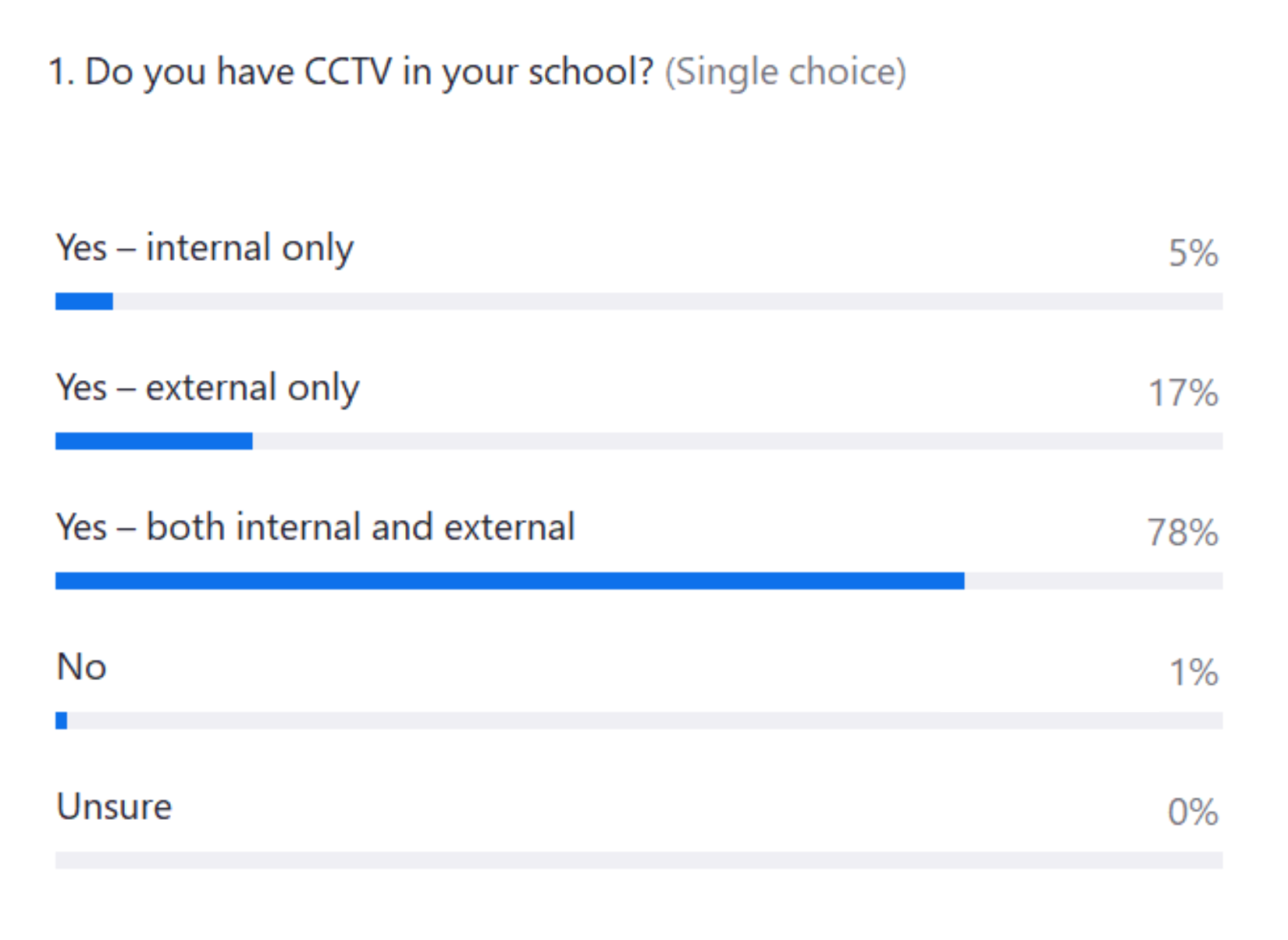
Poll 1 - Part 2
.png)
What is CCTV, and why is it linked to Data Protection?
CCTV refers to a type of surveillance camera that is used to record and store footage within tapes or a digital format. Due to the advances in technology, CCTV is no longer just grainy security footage. It now captures high-quality images (sometimes audio) and can identify people, track behaviour, and be stored indefinitely.
CCTV is considered privacy intrusive, which is why it is linked to data protection. It allows a school to capture and, in many cases, record images (possibly audio) of everyone present on the school site. Those who are caught by CCTV are usually identifiable, and this is considered personal data, which is why processing should be in line with the data protection principles.
Where Do Cameras Exist in Your Own School
CCTV cameras can be set up both in external and internal areas, such as:
- Carparks
- Gates
- Reception
- Corridors
- Classrooms
- Sometimes toilets and changing areas
CCTV isn’t just about burglars. It captures children, staff, parents, and visitors, all day, every day.
Why Do Schools Use CCTV?
Usually it’s for:
- Safety
- Security
- Vandalism
- Theft
- Behaviour management
Poll 2, Part 1
.png)
Poll 2, Part 2
.png)
Where CCTV is Necessary, Justified and Proportionate
Although there are legitimate reasons for CCTV, under UK GDPR, you should not install cameras anywhere you like. It is important to establish the legal reasoning behind CCTV use to meet one of the fair processing conditions as highlighted by the Information Commissioner's Office. Schools usually rely on legitimate interest to run CCTV, and you must prove it is necessary, justified and proportionate. This is where schools often stumble, as there are common myths that because it’s a school setting, CCTV is automatically okay.
You must be able to answer three questions:
- What problem are we trying to solve?
- Does CCTV actually help?
- Is there a less intrusive way?
What Reasons Did Your School Have When CCTV Was Installed?
Some of the positives are:
- Protects school property
- Deters intruders
- Identifies unauthorised people
- Supports investigations
- Can help with safeguarding
Disadvantages of CCTV are:
- It captures huge volumes of personal data
- It creates subject access requests
- It can invade privacy
- It can lead to complaints, investigations and fines
Poll 3
.png)
Data Protection Considerations and Good Practice
With the disadvantages of CCTV, schools and trusts need to consider what safe and manageable procedures are in place to ensure they are remaining compliant.
CCTV Policy
Every school should have a specific CCTV policy that is not incorporated into another policy.
It should include:
- Where cameras are
- Why they exist
- Who can access footage
- How long it’s kept
- How requests are handled
Data Protection Impact Assessment (DPIA)
DPIAs are a process required under UK GDPR when an organisation is planning any activity that is likely to pose a high risk to individuals’ privacy. CCTV is classed as high-risk processing because it is intrusive and continuous.
New CCTV: You must do a DPIA before installation.
Current CCTV: If your CCTV has been in operation for several years and is ready to be upgraded, you should do a DPIA, as it's considered new technology with more risk. A common question we get is, ‘What should I do if our CCTV system was implemented pre-2018?’ A DPIA won't be automatically required, but if the purpose has changed or you have concerns, it's strongly recommended to carry out a review of an existing DPIA or do a new one.
Case Study: Secondary School Reprimanded By the ICO
A secondary school installed facial recognition in their canteen to speed up lunch queues. Previously, they used fingerprint readers, but in March 2023, they upgraded to facial recognition. The school had 1,200 students, aged 11 to 18, so the system processed large amounts of children’s biometric data.
What went wrong:
A DPIA is mandatory when you process biometric data, especially for children. This was not completed until eight months after the system went live. That meant risks weren't identified, alternatives weren’t considered, and compliance wasn’t checked.
The school sent a letter to students, staff and parents stating: ‘We will use facial recognition unless you opt out.’ However, biometric data requires explicit, opt‑in consent, and it must come from the student themselves if they are competent, not the parent by default.
This meant the system ran for months without any lawful basis. They introduced a high‑risk technology without speaking to their DPO and without giving students a real choice.
What did the ICO do:
The ICO issued a formal reprimand under Article 58(2)(b) of UK GDPR. This is significant because reprimands are public and indicate that the school has committed clear UK GDPR breaches.
The reprimand said the school had:
- Unlawfully processed biometric data
- Failed to carry out a DPIA
- Used an invalid consent model
- Deprived students of their rights
The ICO was clear that DPO oversight would have prevented these issues.
Lesson 1: Always carry out a DPIA
Lesson 2: Consent must be opt-in
Lesson 3: Always consult your DPO before you make decisions
Lesson 4: Don't rush technology rollouts
Always complete due diligence, check providers, assess risks, and make sure you have a lawful basis before you switch a system on.
CCTV LOG
- Keep a record of any previous requests, who they came from and why
- Monitor who can view the footage, when and how often
Every school setting will be different, so consider the appropriateness of who has access to CCTV footage and why it is necessary.
Data requests
This can often be requested by the police.
This can be an uncertain area for most schools, as providing that footage means you’re sharing the data of all individuals caught within the video.
Consider before providing the footage:
- Whether the request is specific enough – have they filled in a data request form or simply phoned into school to request this without giving a valid reason?
- Are individuals identifiable
- Does your CCTV have the capability to blur / crop
- Is there a different method you can use outside of providing the footage?
- This is considered to be a subject access request, so schools must follow the ICO guidance when releasing the footage.
What Steps to Take to Minimise Data Protection Risk
How Long Should You Keep CCTV Footage?
There is no legal time frame for how long to maintain footage. Essentially, the guidance is that you should only keep footage for as long as necessary. Practically speaking, most footage should be kept for no longer than 30 days, and your retention limit should be outlined in your Data Retention Policy and CCTV Policy.
The only time you may hold footage for longer is when there is a concern, such as when someone has made a data request.
Is It Okay to Fit CCTV Cameras in Any Location?
Externally: To the best of your ability, these should not cover people's houses or public footpaths. This is not always possible when cameras are facing the front/back gate. Some overspill is okay, just as long as it is not facing into another property.
Internally: Avoid CCTV in sensitive areas such as bathrooms, toilets, and changing rooms, which are places where pupils and staff have a high expectation of privacy.
As part of improving our CCTV governance, we’ve been working closely and openly with the ICO, especially when looking at higher‑risk areas, such as spaces near bathroom facilities.
We carried out a series of DPIAs, and instead of avoiding the difficult questions, we actively brought the grey areas to the ICO’s attention. The aim was to understand the risks properly and make sure they were addressed in the right way.
Through those conversations, the ICO advised us to pause submitting further DPIAs while they undertook a wider review of CCTV use in and around bathroom environments.
Our engagement helped highlight this as an area that needs broader regulatory guidance, and it reflects our commitment to taking a responsible, leading role in shaping good practice in a space where the rules are still evolving.
How Can We Cover the Data Protection Principle of Transparency?
Make sure staff, parents and pupils are aware that CCTV is in operation. This can be done through appropriate signage in areas where CCTV is located and recording. Appropriate signage should be clear that CCTV is in operation, there should be a named contact and a method to contact that individual, e.g. a phone number. Where CCTV is yet to be implemented – informing the various stakeholders in the school, either via letters, briefings sessions, or consultations, is a great way to field any concerns early.
If your school has a lot of CCTV, you do not need signage for every camera. However, there should be sufficient and clear signage in areas with high presence of CCTV throughout the school premises.
Key takeaways
- Consult your DPO before installing/upgrading CCTV.
- Review whether a DPIA is necessary.
- Consider camera placement and awareness.
- Have a specific CCTV policy.
- Speak to your DPO when handling data requests.
How Judicium can help...
You can find information regarding our School Data Protection service here.
Jedu is Judicium's online GDPR compliance tracking software for schools. Our platform is suitable for single schools to large MATs and is designed to assist schools with two critical needs: To enable trustees, Governors and other SLT to monitor GDPR compliance; and to assist you in managing your data protection.
If you would like more information on how we can support you or more information regarding Jedu, please get in touch with us.
If you require any support in any of these steps or would like to talk to someone about some support for your school, please do not hesitate to call us on 0345 548 7000 or email georgina.decosta@judicium.com.
Follow us on Twitter: @DPOforSchools and @JudiciumEDU.
© This content is the exclusive property of Judicium Education. The works are intended to provide an overview of the sofa session you attend and/or to be a learning aid to assist you and your school. However, any redistribution or reproduction of part or all of the contents in any form is prohibited. You may not, except with our express written permission, distribute or exploit the content. Failure to follow this guidance may result in Judicium either preventing you from accessing our sessions and/or follow-up content.
(4)(2)(1)(2)(1)(1)(1)(1)_1000.png)
(1)_1000.png)
_1000.png)