
_1000.png)
This is a summary from Judicium’s Safeguarding and Thrive ‘Sofa Session’ from 3rd December, with our Judicium Safeguarding consultant Joanne Bocko, Thrive Head of Innovation and Principal Trainer, Viv Trask-Hall and Director of Thrive, Tom Preston. Drawing on decades of combined experience in safeguarding, governance, SEND, leadership, and mental health, the panel unpacked how the framework’s shifts will impact schools, what Ofsted will be looking for, and how leaders can position themselves for success.
Today's session will discuss the updated Ofsted framework, published in September 2025.
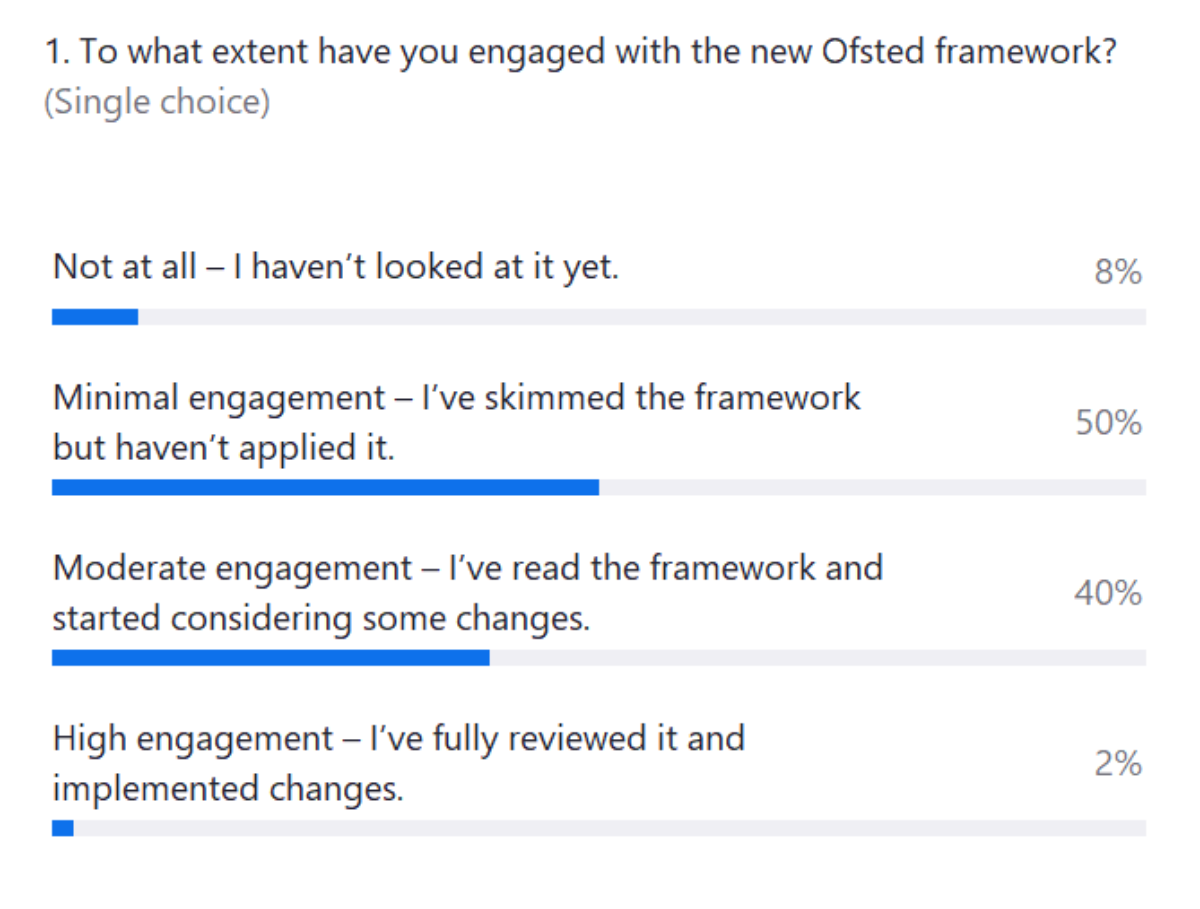
Poll 1
Ofsted's New Grading System and Change of Language
Ofsted's new grading system, a 5-point grading scale (Exceptional, Strong Standard, Expected Standard, Needs Attention, Urgent Improvement), replaces the traditional four-point scale (outstanding, good, requires improvement, inadequate). The new grading system now reflects that schools have the ability to improve, rather than shattering confidence to achieve.
Each section will receive their own grading for each judgement area, creating greater visibility and accountability.
The judgements areas are broken into the following:
Curriculum and teaching
Early Years/ Post-16
Achievement
Inclusion
Leadership and governance
Personal development and wellbeing
Attendance and behaviour
From Best Fit to Secure Fit
Ofsted is moving from a best fit to a secure fit model.
This means:
-
Schools must meet every criterion within a judgment area
-
If one element is not evidenced, the school may drop to the next band
-
Inspectors will look for sustained impact, not isolated examples
This is a major change. In practice, it demands a higher level of consistency and a more strategic approach to evidence gathering and monitoring.
The new categories shows increased focus on specific areas. Leadership and management has changed to leadership and governance placing more emphasis on appropriate strategic challenge from governors and trustees. Based on Judicium's experience in audits, this is a common area needing improvement.
The quality of education is replaced under two headings of curriculum and teaching and a separate category for achievement. Personal development now includes wellbeing, which will consider new mental health support teams, budget spending and new ideas.
Behaviour and attitudes has changed to attendance and behaviour.
Poll 2
.png)
Inclusion
The panel emphasised that inclusion has become a central pillar of the new framework. Our poll showed it was the area school leaders said they felt most nervous about.
Thrive’s Tom Preston reinforced why: inclusion now sits prominently as its own judgment area and runs through almost every other descriptor. Schools must evidence not just provision, but meaningful impact for learners with SEND and other vulnerabilities.
Inclusion now has its own judgment area and sits woven through almost all the others. Every team within a school from classroom staff to senior leaders to governors and trustees, must be able to articulate:
-
How pupils with SEND and additional needs are identified
-
How their needs are met in everyday practice
-
How interventions lead to meaningful change
This means showing impact, not just provision. Inspectors will be looking closely at individual pupils, including those with persistent attendance challenges or complex needs.
Example:
An example in Viv's experience of a child repeatedly tapping in the classroom, illustrates a key principle in the new Ofsted framework:
-
A behaviour like tapping may seem low-level or disruptive, but it is often a regulation strategy. The child is using it to manage emotions, anxiety, sensory overload, or uncertainty.
-
When staff recognise this, they shift from seeing the behaviour as misbehaviour to seeing it as information about what the child needs.
-
Interventions become more supportive and targeted, such as offering movement breaks, sensory tools, or predictable routines.
Attendance & Behaviour: A Combined, High-Scrutiny Area
National concern around attendance is reflected in its new pairing with behaviour. The scrutiny here has increased significantly:
-
Schools must show systematic processes for improving attendance
-
They must evidence how these processes influence individual pupils
-
Behaviour must be understood as communication
-
Staff must present a consistent narrative about expectations, behaviour strategies, and outcomes
The Working Together to Improve School Attendance guidance is now statutory, meaning leaders must ensure it is understood, implemented, and evidenced.
The Growing Importance of Governance
The session highlighted the increasing importance of governance, particularly safeguarding governance. Inspectors may now request:
-
Meetings with the safeguarding link governor
-
Meetings with the safeguarding trustee in MATs, and evidence of how governance supports, challenges, and monitors safeguarding culture.
Both Judicium and Thrive have seen a marked rise in requests for external governance reviews, reflecting leaders’ desire for assurance under the new framework.
DSLs also benefit significantly when safeguarding governors are closely involved — sharing the load, supporting requests for resources, and helping shape improvement priorities.
Judicium's external review for governance strengthens your board by identifying areas for improvement in leadership, accountability, and compliance—ensuring effective decision-making and long-term success. Find out more here.
Workload and Wellbeing
Schools must take the wellbeing implications of the framework seriously and ensure staff have protected time, support, and clear channels for reflection.
The panel explored how the new framework intersects with staff wellbeing. Wellbeing assessments during inspection may feel daunting for staff who already feel stretched.
This is where DSL supervision supports in managing complex emotional loads and decision-making pressure, especially around attendance, inclusion, and safeguarding thresholds.
Schools should ensure:
-
Staff feel safe to speak openly
-
Supervision is embedded into DSL support
-
Wellbeing strategies include protected time, not just initiatives
-
Governors understand workload pressures to support resource decisions
Judicium’s Safeguarding Supervision Service provides essential reflective practice sessions to help your safeguarding team manage their workload effectively, meet statutory requirements, and address the emotional challenges of safeguarding children.
Early Years & Nurseries: A Distinct (and Often Overlooked) Area
Nurseries and early years settings should not be treated as miniature versions of primary schools. They have unique requirements under the Early Years Foundation Stage, including differences in:
-
Online safety
-
Supervision
-
Policies
-
Documentation
-
Staff ratios and training
Many leaders only recognise these differences during external audits so now is the time to ensure EYFS evidence matches EYFS expectations.
Safeguarding Culture
For safeguarding, it will state whether safeguarding standards are met, or not met, rather than effective or not effective. The caveat for these standards where safeguarding is met states:
The school has an open and positive culture of safeguarding. All legal requirements are met.
Pillars of safeguarding culture now under closer inspection:
-
Safer recruitment
-
Staff training
-
Site security
-
Record-keeping
-
Clear DSL leadership
-
Clear roles for governors and trustees
-
Confident, consistent staff understanding
Judicium offer a wide range of CPD accredited training from Governance and Clerking, HR to Safeguarding. Held throughout the year and also can be exclusively delivered to your school. View our full catalogue here.
Poll 3
.png)
Thrive Approach - Wellbeing Tool & Evidencing
Schools should shift from documenting what was offered to collecting evidence of what changed. Inspectors want to see:
-
Progress over time
-
Impact on attendance, behaviour, or wellbeing
-
Clear pupil voice
-
Joined-up understanding across staff
This is no longer a paperwork exercise; it is about demonstrating a consistent, lived culture.
How can schools prepare to evidence a 'secure fit' rather than a 'best fit' for personal development and wellbeing?
The evidence focus here leans more heavily towards systematic data and consistency of application, scrutinising not just the culture, but the effectiveness of systems designed to ensure pupils are present, punctual, and ready to learn.
Points to consider:
- Understand the secure fit vs best fit judgement.
- To pass the secure fit test and ensure schools meet the expected standard, the audit must confirm universality, consistency and impact.
- Collect sustained, consistent data - evidence must be sustained (over time) and consistent (across the school or trust).
- Prepare staff and pupils for the narrative - a consistent narrative across all interviewees, e.g., staff, pupils and governors providing examples of how they contribute to wellbeing.
- Early Years PSED
My Thrive Scan helps you identify strengths, spot emerging needs and demonstrate how your school or MAT supports every child to thrive. It gives you clear, evidence-based insight into how your pupils are doing and how well your provision supports them. The results make it easy to demonstrate to Ofsted, governors, and trustees how you monitor, evaluate, and improve wellbeing over time. Your School Wellbeing Snapshot provides the visual evidence you need to show your school’s impact and inspection readiness.
If you want to plan targeted SEMH support, you can upgrade to the full Thrive-Online subscription (which includes My Thrive Scan). Thrive-Online offers 1:1 and small-group SEMH assessments that generate tailored action plans and strategies for individual pupils, delivered by a Thrive Licensed Practitioner who leads this work in your setting.
Key Takeaways
Implications for Schools
- Evidence collection– Schools and trusts should maintain detailed evidence of inclusive practices, mental health initiatives, and staff development linked to inclusion.
- Curriculum design – Ensure curriculum intent and implementation explicitly reference inclusion and well-being principles.
- Leadership accountability – Governors and senior leaders should monitor and evaluate inclusion and well-being and be able to evidence strategic challenge and the impact of this.
- Staff development – Provide continuous CPD on adaptive teaching, equality, and mental health literacy.
- Whole-school culture – Embed belonging, representation, and proactive support for both pupils and staff into the school or trust's ethos, which in turn, supports attendance, inclusion and wellbeing.
How Judicium can help...
You can find information regarding our Safeguarding and SEND service.
If you require any support in any of these steps or would like to talk to someone surrounding some support for your school, please do not hesitate to call us on 0345 548 7000 or email enquiries@judicium.com
Follow us on Twitter: @DPOforSchools and @JudiciumEDU
© This content is the exclusive property of Judicium Education. The works are intended to provide an overview of the sofa session you attend and/or to be a learning aid to assist you and your school. However, any redistribution or reproduction of part or all of the contents in any form is prohibited. You may not, except with our express written permission, distribute or exploit the content. Failure to follow this guidance may result in Judicium either preventing you with access to our sessions and/or follow up content.
(1)_1000.png)

_1000.png)