_1000.png)
This blog is based on Judicium’s Facilities ‘Sofa Session’ from the 14th January 2026, with our resident expert Joanne Fisher and Neil Merry. This session focused on premises safety, planning day-to-day, and contingency plans for when your caretaker is absent. Practical tips for auditing and ensuring correct regulations and training are in place.
Combination Audits and Compliance Within Your School
Audits and compliance have become key words in education in recent years. It doesn’t seem like too long ago that the emphasis for premises was centred around cleaning and contractor management, and how much could be saved on maintenance. That’s obviously still important, but compliance checks have fast become a priority for schools and MATs.
There are a myriad of requirements and various delegations across your school. How do you know that every check is being carried out, recorded, and accessible? It’s very easy to get lost in audits, and indeed, when visiting schools, it's clear that it’s incredibly easy to get tied up in knots with what’s required across all levels. Are we in danger of having audits to monitor audits? You can see how it can spiral!
Poll 1
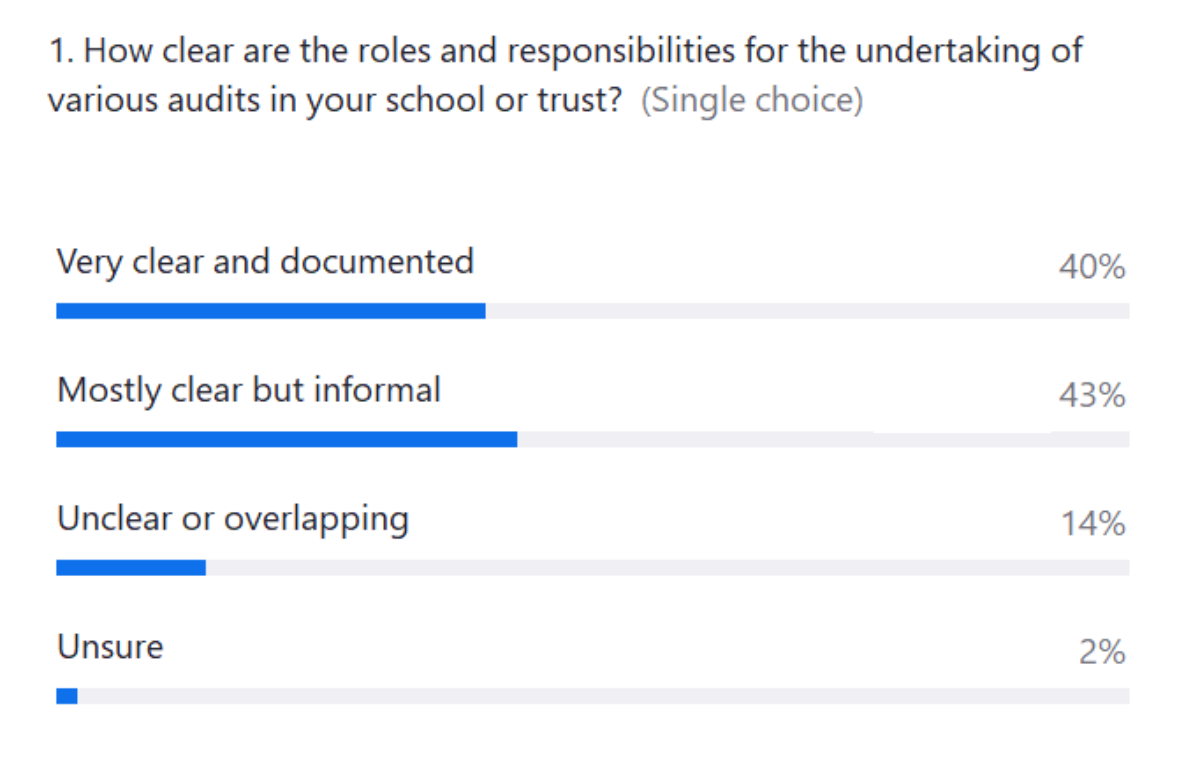
Working with schools for several years has sadly shown Neil and Joanne many examples of when unclear delegation and lack of training can go wrong. I think the biggest example for them that comes to mind is a secondary school in London.
Case Study – Client Secondary School in Redbridge
We were contacted by the school following an incident with a routine chemical application for their pool area. A member of staff had accidentally mixed chlorine and acid whilst carrying out what should have been a routine procedure. This resulted in the production of chlorine gas.
The effects of this can cause severe irritation to the eyes, nose, throat and lungs. It can also cause coughing, chest pain and fluid in the lungs, leading to severe injury or even death. The result of this error not only closed the school and the surrounding areas, but the member of staff also suffered several side effects leading to hospitalisation. We were able to identify training issues within the school team and provide support accordingly.
The main contributing factor was the poor record management system in place. The entries for the chemical levels were completed 3 months in advance.
Thankfully, he was ok. However, as in many other areas, COSHH, cleaning, use of power tools, fire safety, and working with asbestos highlighted the need for training and implementing the correct policies and procedures. Practical awareness was also a huge factor in this case.
Is your School or trust up-to-date with compliance and workplace legislation? Attend our CPD-accredited course on health and safety for premises managers. This one-day course includes fire safety and CDM regulations. For more information, click here.
Poll 2 - Part 1
.png)
Poll 2 - Part 2
.png)
According to HSE, 70% of accidents in schools result in injury to pupils - an alarming statistic.
Keeping Schools Safe: What a Combination Audit Can Do
Combination audits are consolidated audits compiled from your other audits in the school. Namely, your H&S audit, internal compliance, planned preventative maintenance, Safeguarding and GEMS. It’s a whole school approach in relation to legislation, compliance and best practice, with senior leaders being aware of policies to continually support the premises staff operating at a practical level.
It is crucial that the school regularly reviews plans and processes in conjunction with its premises team and that these are regularly updated. Although constant reviews of policies are essential, it is also important to recognise what goes on in your school day-to-day.
Are you confident that your staff are fully trained in their area of work? When were they last trained?
The outcome of our support in the Secondary School in London was that the correct procedure could not be followed because the member of staff did not have adequate training in place. The anticipatory recording of chemical levels was fraudulent and could cause a repeat of the incident, confusion amongst staff and danger to staff and users.
Top Tips When Creating a Combination Audit:
- Check existing audits – where are they, who looks after them? Are they up to date? List them out. Look for possible overlaps in who carries them out because you may be doubling in some areas and missing others. The outcome you’re looking for is one piece of evidence that satisfies several requirements. As an example, risk assessments could overlap with safeguarding, premises and H&S.
- Build staff confidence through clear, shared ownership of the whole audit and not just sections of it. You could delegate compliance leads per area (not just SLT, business managers, premises staff), Short, focused briefings rather than long training sessions to counteract audit fatigue and explain why the checks exist, not just what they do and how to do them. It just builds some context and puts a real-life spin on what can sometimes be considered a tick-box exercise.
Good Estates Management in Your School
GEMS - Good Estates Management.
Much of education's Health and Safety talks about risk assessments, polices, and procedures, but internal compliance checks should take place every day, week and month within your premises team. Some examples of what your premises team should be checking are:
- Emergency lighting
- Fire Alarm
- Internal asbestos inspection in relation to your asbestos management plan
- Water flushing/legionella
- Disabled pull cords
So, how do you know exactly what should be checked and how often? The list is extensive and can change depending on your school. A primary school would have similarities, but this would not be the same for a secondary or SEND school. The list above and all your statutory inspection requirements should be in your school’s health and safety policy, which is agreed by your school’s governing body.
Poll 3
.png)
The challenges with implementing good estate management are that it often gets pushed down the pecking order in the normal day-to-day reactive work that demands the time of a premises team in any school.
Netball Posts Vs Monthly Inspections
A PE teacher would like netball posts moved indoors due to bad weather at short notice, just at the same time that the premises team is completing a monthly inspection that requires time and documentation. You can see how easy it is for things to slip and then possibly be left. The responsibilities and expectations of premises personnel in your school are far more important than they ever have been, with no sign of this changing.
Without allowing structured time for premises to carry out these checks, you run the risk of a non-compliant site, i.e. 24 hours, and then you’re looking at firefighting measures. Alongside this, your team will also be dealing with day-to-day operational work, hiccups, reactive maintenance, and proactive maintenance (gutters). All of this is before anything major that might come in. The weather alone can add huge amounts of time to a working day for your premises team.
One of the main things Neil hears from site staff is that they’re not given the time to complete the checks and that the 'importance' isn't a factor until the school is audited or there’s damage to the building. Suddenly, the netball posts become less important.
What can you do?
- Allocate time to compliance alone, identify key areas for inspection and make it a designated task rather than ‘if you’ve got time’.
- Educate your colleagues about how important it is to allow the premises team to carry out these checks and emphasise that site compliance is to safeguard not only every school user, but the building itself.
If you’re able to adopt this, then you could be looking at:
- Financial benefits – lower reactive maintenance costs.
- Operational – fewer failures, clearer prioritisation.
- Builds confidence in your whole school family, creating a happier working environment.
- A better teaching and learning environment.
Contingency Plans For Premises Absence
When premises personnel are not there, who looks after your school? Is there an opening-up procedure in place? Is this person aware of visitors, contractors, and cleaners? Do they know the school’s sign-in process? Are any of these first aiders? Is there a fire warden on site during your premises' opening hours? Most importantly, do they know what tasks are required of them while they’re there? Many problems are discovered first thing in the morning when the least amount of people are in your school.
Any colleague who has had to step in and carry out caretaking duties such as, opening/locking up, gritting paths, traffic patrol, gate duty, porterage, spillages, will know your scheduled compliance list is endless. You will know that it’s a very extensive job and one that can be made much harder if there’s no action plan or schedule in place.
Poll 4
.png)
If you’re in London, we offer our person-to-person cover service. For those outside of this area, how do you ensure that everything is getting done in the absence of your usual member of staff?
A crib sheet is essentially a school information plan (foolproof guide, ABC schedule) - which has to be a completed, up-to-date and lists a rundown of everything that your member of premises staff needs to know in a day. It should be detailed and include everything from contact numbers to alarm codes, key handovers, gate timings, contractor details, etc, etc. For example, if they’re opening up and have cleaning staff arriving, they’ll need to know the name of the company to ensure security.
Top Tips
- Check on the overlap of the contents of audits. Are you doing the same checks more than once?
- Understand the importance of allowing premises staff the time and space to carry out these checks.
- Know what contingency plans are in place and the premises process when caretakers are absent.
Judicium Education can help...
Our combined Facilities Management Services ensure the pupils in your care have a place of learning that is safe, compliant and a pleasant place to be.
Judicium Education’s Facilities Management Service is designed to support schools, firstly, in ensuring a safe working and learning environment, secondly, in complying with the legal requirements. For more information, please visit here.
If you require any support in any of these steps or would like to talk to someone about some support for your school or trust, please do not hesitate to call us on 0207 336 8403 or email enquiries@judicium.com
If you’d like to review Judicium’s forthcoming sofa sessions, please click here.
© This content is the exclusive property of Judicium Education. The works are intended to provide an overview of the sofa session you attend and/or to be a learning aid to assist you and your school. However, any redistribution or reproduction of part or all of the contents in any form is prohibited. You may not, except with our express written permission, distribute or exploit the content. Failure to follow this guidance may result in Judicium either preventing you from accessing our sessions and/or follow-up content.

_1000.png)