_1000.png)
This is a summary taken from Judicium’s Governance ‘Sofa Session’ from the 25th February, with our Governance Expertise and Partnership Lead, Steve Barker.
The decision-making that we are reflecting on relates to decisions made by governor and trustee panels in schools and trusts, set up to review the permanent exclusions of pupils.
Governor panels can only make two decisions:
- To uphold the headteacher’s decision to permanently exclude a pupil
- To direct reinstatement of the pupil, thus overturning the Headteacher’s decision.
At Judicium, we firmly believe that each Governors’ Exclusion Panel needs to include in its thinking and its actions/decisions how they will be interpreted and judged by an Independent Review Panel (IRP), if they, as governors/trustees, uphold the headteacher’s decision to exclude, and that the parent/carer requests an IRP.
Poll 1 Part 1
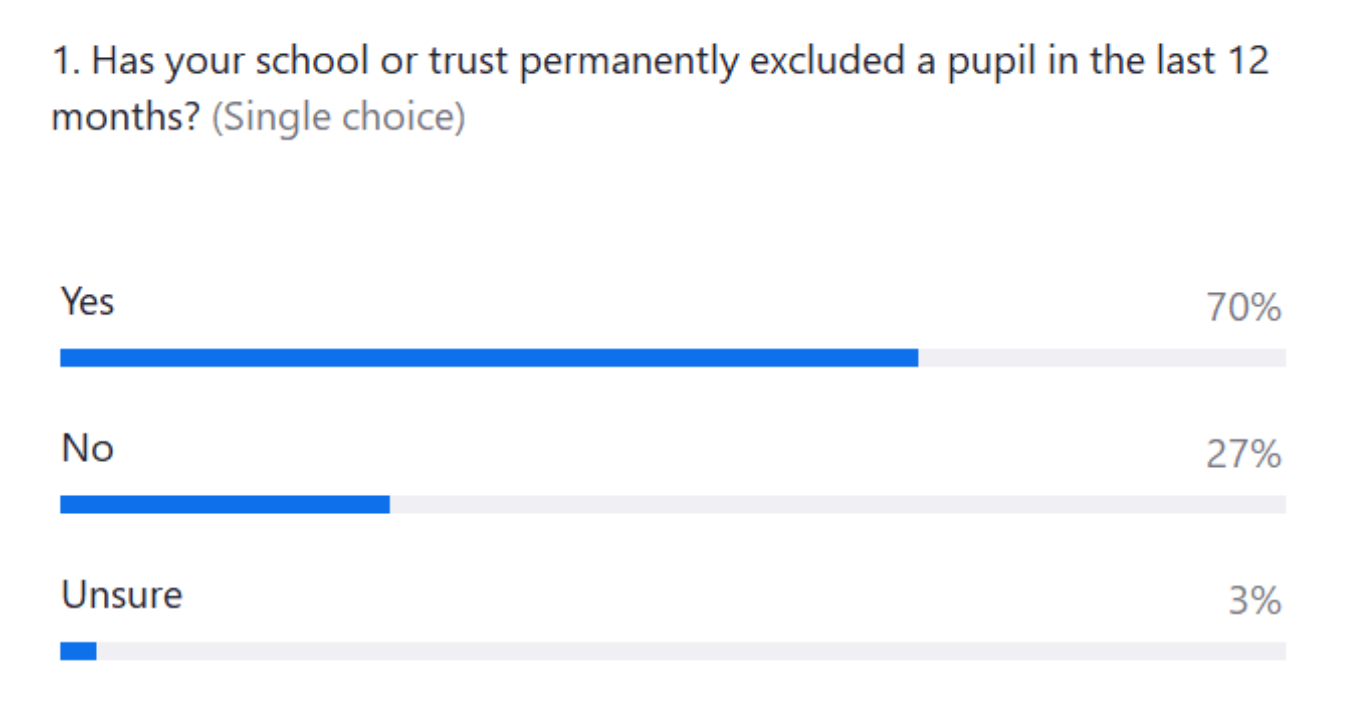
Poll 1 Part 2
.png)
The Importance of an Independent Review Panel (IRP)
At government level, there are growing concerns about the level of exclusions, and whilst there was a slight dip (down 3% Autumn Term 24/25 vs the previous year), the data is over a year old despite being updated in Nov 2025. The feeling nationally is that exclusions are on the rise again. We also know that requests for IRPs are climbing, and again, anecdotally, we hear from all over the country that IRPs appear to be growing in terms of some of the outcomes and the feedback coming to schools and trusts within outcome letters. This places a significant caveat on decisions made by school panels, as they should always be considering the possibility of an IRP and how members might view those decisions.
What members will consider:
- The evidence provided to governors
- How governors took this into account in making their decisions
- How governors considered all verbal submissions during the panel hearing
- Whether principles of Natural Justice were followed
- Whether panel's decision reflect the civil standard of proof
- Whether school polices and statutory guidance was followed
- Was the panel conduct procedurally fair
- Was consideration given to the Equality Act 2010 and the Human Rights Act of 1998 (esp. section 3)
How Significant are IRPs for Schools and Trusts?
A good Clerk or Governance Professional will support the panel to ensure they are mindful of potential pitfalls and that the outcome letter, record of the panel meeting, and the paperwork received are fit-for-purpose. We do know from published data that there were 810 IRPs held, 236 for maintained schools and 574 for academies (DfE 2023-24). That means academies are excluding far more pupils than maintained schools.
This most likely reflects the system/structure right now. More secondary schools are academies than are not, which is not the same in the maintained sector, and exclusions in secondary schools are far higher than in primary schools. Although exclusions in the primary sector are on the increase, in the secondary sector they are falling, according to the most recent data. Overall, we hear that IRPs are being requested more and more across both maintained schools and academies and that decisions from IRPs are not, by any means, always supporting schools. Whilst 61% of governors' panel decisions were upheld in 2023-24, 39% were not. The 39% that were not upheld resulted in a recommendation to reconsider, and almost half were directed to reconsider.
DfE guidance on suspension and permanent exclusion states:
"If a panel directs a governing board to reconsider reinstatement it may order the local authority to adjust the school’s budget or (in the case of an academy) the academy trust to make an equivalent payment to the local authority in whose area the school is located unless, within ten school days of receiving notice of the panel’s decision, the governing board decides to reinstate the pupil. Paragraph 231 provides statutory guidance to panels on the circumstances under which this payment should not be ordered. The sum of this adjustment/payment must be £4,000 and would be in addition to any funding that would normally follow a permanently excluded pupil. The panel does not have the power to order a financial readjustment or payment in circumstances where it has only recommended that the governing board reconsider the reinstatement of the pupil."
Poll 2
.png)
Good and Effective Clerking
The clerk or governance professional's role in a permanent exclusion panel hearing is:
- To understand the process
- Be appropriately trained to provide support
- Offer advice and guidance to the governor's panel members
- An understanding that an IRP will, if requested, scrutinise every aspect of the panel hearing
A good clerk or governance professional knows what an effective panel looks like, will help steer governors and trustees through the potential pitfalls, and will know what IRPs look for.
Heads and Principals should be mindful of the threat of reputational risk. The biggest risk factor in IRP outcomes is when the school or trust (including the governor panel) cuts corners, overlooks the legal framework, including equality legislation and disregards natural justice principles. If you allow ourselves to be subject to any of these potential pitfalls, you are encouraging an unfavourable outcome should the parent/carer request an IRP.
Natural Justice
Natural Justice principles should underpin all that schools and multi-academy trusts do regarding pupil behaviour and the use of sanctions as a response to poor behaviour. In Law, natural justice is all about the right to a fair hearing, which includes absence of bias. In a single word, Natural Justice is all about fairness.
An IRP will look for evidence these principles have been applied at an Exclusion Panel hearing, which in practical terms should include evidence that;
- Interests were declared by governors
- No one, including the headteacher, was ever alone with the panel before or after the hearing
- Evidence was shared with everyone present (5 days before)
- Each party (school and parents) got to put their case and questions to the other party
- Reasonable adaptations were considered and made where appropriate for SEND pupils (by the PEx panel)
Example:
A school had permanently excluded a pupil as a result of threats of violence against a member of staff, made in text messages. The school had barred the accused pupil from the school site, had not taken a statement from the pupil and had not asked for a written account from the student about the allegations. Governors at the PEx panel had not questioned this, and the pupil was told they could not attend. When the IRP was held, this was off-site, with the pupil and their parents present, and it soon became clear that the phone in question did not belong to the accused pupil. The police had earlier confirmed this, but this had not been raised by the panel. Clearly, this lack of evidence is totally prejudicial and flouts all expectations of ‘fairness’. It wasn’t a fair decision for the panel to uphold the headteacher’s decision, and so the IRP rightly quashed it.
SEND Adaptions
Reasonable Adaptations are critical if the pupil has SEND needs. It is fundamental for headteachers and governors sitting on a PEx panel to be aware when a pupil has special need by it being stated in the pack. The pack should include full, exhaustive details of all adaptations put in place to support meeting the pupil’s needs. An IRP panel will assess this. The panel should always seek assurance that there is evidence that adaptations were made and reasonable (in terms of such use of Reasonable Adaptations recognising individual needs, before exclusion).
This can involve a wider variety of measures, including but not limited to the following examples:
- Reduced timetable
- Time-out cards
- TAs trained to recognise triggers
- Variation of sanctions in behaviour policy
- Deviation from policy/daily routines, including suspension & exclusions processes
- Review of provision appropriateness (but this is no reason to PEx)
The Impact of Packs on an IRP Outcome
The pack is extremely important and should include all relevant information and data. The DfE guidance spells out the statutory requirements relating to the process, and it makes sense to ensure the pack contains evidence that all these elements have been met. The pack should include:
- A copy of the Headteacher’s letter notifying parents/carers of the exclusion
- Correspondence with parents (to and from)
- Witness statements (redacted if appropriate)
- Pupil behaviour log
- Details of any SEND (including reasonable adjustments made to avoid PEx)
- Investigation report (if it exists)
- Contextual info. (if appropriate)
- Evidence (CCTV, photographs, physical)
- Copy of Behaviour Policy
- DfE Suspension & PEx Guidance
- Statement from parents/pupils
- Social Care and Virtual School (if relevant)
The pack should provide a full picture of the pupil and the event that led to the PEx. If the pupil has SEND, then all evidence must be included.
Consequences
At an Independent Review Panel, the members of that panel will look at the evidence considered by the PEx Panel, and they will also look at relevant case law. IRPs are expected to consider case law when making their decisions and DfE guidance (par 213) makes explicit reference to this along with potential claims of discrimination linked to the PEx. It is particularly relevant if the excluded pupil has SEND, as SEND pupils are overrepresented in the PEx data. There is also an expectation that clerks or governance professionals (to an IRP) are aware of case law so this can be reflected in their advice to IRPs.
Example:
The Governing Body of a School had a case heard at the Upper Tribunal in August 2018. In essence, this case confirms schools must be proportionate in using PEx to demonstrate they have not discriminated against a pupil in relation to their disability (Section 15 of the 2010 Equality Act). The IRP must look at what the school did in terms of reasonable adjustments in light of a pupil’s needs. Following policy is not enough - schools must be able to show that the behaviour policy (root of all exclusions) is applied fairly, not equally.
Training
There is an expectation that governors, trustees and clerks have access to training so they can discharge their responsibilities. PEx panels have been criticised for not engaging in training in the past two years before the PEx, despite there being no statutory duty relating to training (except for the IRP members and clerks). Training is essential, and PEx panel training is one of the most popular sessions that we offer, both for govs trustees and for Clerks, considering there is so much at stake from IRPs and the threat of first-tier tribunals. For upcoming PEx training please visit HERE.
3 Key Tests
IRPs must apply three key tests based on the principles applicable to judicial review. They are:
- Illegality – Did the PEx panel act outside the scope of its legal powers? Stick to the law (including Equalities legislation in all its complexity). You can only exclude for behavioural reasons.
- Irrationality – Did the PEx panel fail to take into account all relevant points, or make a decision so unreasonable that no board acting reasonably could have made it?
- Procedural impropriety - was the decision so procedurally unfair or flawed that justice was clearly not done?
Asking the Right Questions
Questions are the foundation of effective governance in all its aspects. Questions are essential in demonstrating how we hold our schools and trusts to account. The ‘right’ questions in a PEx panel situation (from governors) are generally those seeking clarification.
The most important consideration is that the agenda for PEx is constructed in a way that allows each party to make their point(s), followed by questions in order. The school will present first, followed by questions from parents/carers, Social Worker/Head of Virtual School, the LA and then panel members. Panel members should actively listen to all submissions, all questions and all responses to the questions.
Panel members must constantly bear in mind that their role is to consider the evidence, written, spoken and seen, including any physical evidence that may be relevant.
It is not for governors and trustees to ask questions that intrinsically favour or support the headteacher, that admonish the pupil or reflect their own personal opinions; they should, where appropriate, seek clarity to inform their decision-making.
Example:
It is not acceptable to ask the pupil who is the focus of the PEx, ‘Do you think what you did is acceptable and sets a good example on how pupils should behave? It is better to say, ‘You mention occasions when X has been bullied, and you felt the school did not act. There is no mention of bullying in the pack; did you or X inform anyone at school on these occasions?
It can be easy to make the wrong decision due to not wanting to disagree, undermine or let down the headteacher, by not upholding the headteacher’s decision. There is Uuseful guidance from the DfE on Suspension & Exclusion:
The Governing Board have a key responsibility in considering whether excluded pupils should be reinstated. This forms part of the wider role to hold executive leaders to account for lawful use of exclusion, in line with the duties set out in law, including equalities duties.
Top Tips
1. ‘The pack’ needs to be thorough, detailed and robust, in terms of the case for upholding the Headteacher’s decision to PEx.
2. Preparation – If you are a Headteacher, go through everything against the DfE guidance, have someone else sense-check it if the pupil has SEND, and ensure you have chapter and verse on adaptations that relate. Read the PEx panel as soon as you receive it, reflect on its contents and then re-read it again the day before, and think about the questions you may have.
3. Have 100% clarity on your role in a PEx, adhere to it and always think - ‘there could be an IRP’
How Judicium can help...
You can find information regarding our Governance and Clerking service here.
Whether it's governance advice, clerking, training, or bespoke school suspensions and permanent exclusions guidance, our expert governance support, compliance guidance, and governing body development help schools and trusts build strong leadership, effective decision-making, and full regulatory compliance, ensuring a well-structured, accountable, and high-performing governance framework.
If you would like more information on how we can support you or more information regarding Jedu, please get in touch with us.
If you require any support in any of these steps or would like to talk to someone about some support for your school, please do not hesitate to call us on 0345 548 7000 or email georgina.decosta@judicium.com.
Follow us on Twitter: @JudiciumEDU.
© This content is the exclusive property of Judicium Education. The works are intended to provide an overview of the sofa session you attend and/or to be a learning aid to assist you and your school. However, any redistribution or reproduction of part or all of the contents in any form is prohibited. You may not, except with our express written permission, distribute or exploit the content. Failure to follow this guidance may result in Judicium either preventing you from accessing our sessions and/or follow-up content.

_1000.png)